

Now that you’ve worked through Discover, Sell, Buy, Build and Implement, it might be tempting to think the hard part is behind you. But in the agentic era, that’s just the beginning. AI agents operate inside dynamic environments where workflows evolve and data is constantly changing. Left unmanaged, even high-performing agents may begin to deliver inconsistent outputs. Being a true managed intelligence provider (MIP) is all about overcoming the gap between initial success and sustained agentic value. Follow as we go through Play 6 of the Managed Intelligence Provider Playbook, Manage, where you turn deployed agents into durable, continuously improving systems.
Why Managing AI Agents Is the Real Differentiator
The market right now is rife with organizations that say they can deploy AI, no problem! But there is a problem: Not every organization can sustain AI agents once they’ve deployed them.
A lot of AI initiatives lose momentum after deployment (more than 60%) because there’s no structured discipline for optimization, governance or lifecycle ownership. Pilot programs gradually go underused or even abandoned in the absence of ongoing AI agent management.
So, instead of viewing implementation as the endpoint, you’ll need to treat it as a transition into an ongoing operational phase. The responsibility shifts from delivering a working system to ensuring that system continues to produce those measurable outcomes you’ve sold your clients on. Agents have to not only adapt to change but expand their impact over time.
The idea is that, because you’ve delivered a digital workforce, your digital workers would stay good at their jobs and even get better over time — just like real employees (ideally). You’re the boss who helps make that happen.
How to Implement AI Agents as a Managed Intelligence Provider
Managing AI agents comes down to making sure they keep evolving after you deploy them. The goal is to ensure agents stay effective, secure and aligned to the outcomes you’ve laid out with your client. This requires setting the technical foundation and embedding a governance layer to keep things working properly and securely.
Let’s Get Technical
At the technical level, managing AI agents means you need to actively maintain them and improve how they operate in production environments. Agents depend on data, integrations and workflows that are constantly changing, so structured oversight helps you make sure they keep performing as they should.
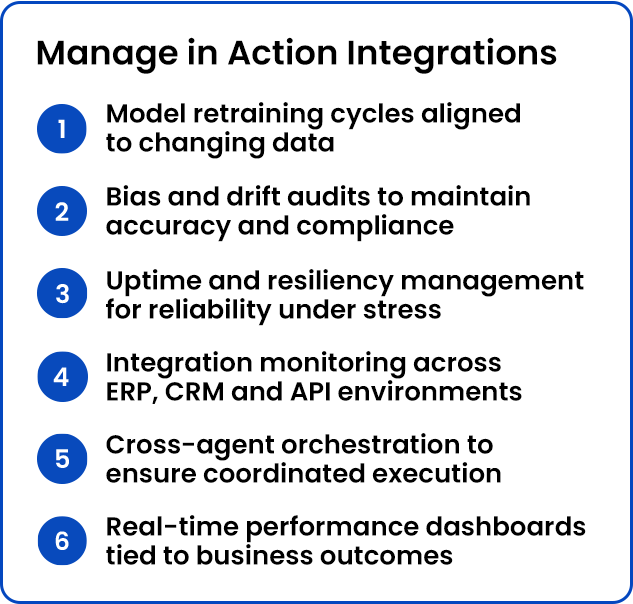
This starts with model retraining cycles, where you’re updating agents on a regular cadence (quarterly or semi-annually) to reflect changing data and business conditions. As inputs evolve, retraining keeps outputs accurate and relevant.
Alongside retraining, you’ll need to conduct bias and drift audits. Monitor agents through automated checks that validate whether outputs are consistent and meeting expectations.
How do you keep AI agents reliable? Uptime and resiliency management helps you ensure agents stay available and functional under real-world conditions, including error recovery and failover when systems encounter issues. This is particularly important as agents take on more critical workflows inside the business.
Because agents rely heavily on upstream systems, integration monitoring becomes essential. Changes in ERP, CRM or API layers must be tracked continuously, with workflows adjusted proactively to prevent disruptions. Small integration changes can quickly send performance levels down the tubes.
As you scale agentic environments, you’ll need to account for cross-agent orchestration. Managing how multiple agents interact across workflows helps prevent conflicts that lead to duplicated efforts or unintended outcomes. Remember, this is digital labor, and your digital employees need to play nice with each other.
Finally, leverage performance dashboards for visibility into how agents are performing in real time. Metrics such as response times and efficiency give both you and your client a clear view of whether agents are delivering value.
Security and Compliance
As your agents act across workflows, you’ll want to minimize business risk. That’s why you need to embed governance directly into how agents operate.
This means enforcing role-based access and maintaining full audit trails. You’ll also need to define clear boundaries for what each agent can and can’t do, along with escalation paths and human override capabilities when your agents bump up against those limits.
As adoption scales, governance gets more important. Many SMBs don’t have internal resources to manage governance frameworks at this level, which makes it a key area where MIPs add value. Getting security and compliance right is one of the most effective ways to expand AI across an organization.
How Can You Earn Revenue Managing AI Agents?
The Manage play is where you turn managing AI agents into a recurring business model. Because agents and workflows shift over time, tracking and improving performance is what creates lasting value.
At a technical level, optimization lives in the details of how agents interact with systems and data. You can make small changes to integrations, authentication or orchestration to materially improve accuracy, latency and cost. But you’ll also have to actively manage those layers to help your clients keep seeing measurable business gains.
In practice, this involves consistently engaging in:
- API and integration tuning
- Protocol and authentication management
- Workflow orchestration refinement
- Performance and cost monitoring
- Feedback loop integration
Individually, these levers may seem like they’d only translate to incremental gains. But together, they can help an agent maintain effectiveness and show improvements month over month.
As you optimize, what you’re looking for are outcomes like faster resolution times, fewer manual interventions and lower operating costs. This way, you can tie your services directly to the impact they’re having. From there, optimization naturally becomes a subscription layer in which you package ongoing tuning and monitoring as a recurring service.
At the same time, optimization exposes where you can expand your offerings. For example, usage data may highlight adjacent workflows and process gaps where agentic automation can help.
That is what turns AI into a compounding model. Optimization improves performance, performance drives ROI and ROI unlocks expansion.
Real-World Ways MIPs Manage AI Agents for SMBs
Here are some examples of how to structure managed services that extend AI value beyond implementation and into long-term business impact, including deploying agents that help you manage other agents (neat trick, eh?).
Use Case 1: Ongoing Optimization Subscriptions
What It Looks Like: Deliver a managed intelligence service that includes continuous prompt and agent tuning, retraining cycles, A/B testing, drift monitoring and version updates, combined with active oversight, like how a manager would monitor and guide an employee. Define KPIs both parties can track through dashboards.
Why It Works: AI agents need active management to maintain peak performance. You and your clients will see stronger results compared to “set-and-forget” deployments.
Your Monetization Move: Offer tiered subscriptions, including higher-value packages with performance targets or guarantees.
Use Case 2: Compliance and Risk Automation
What It Looks Like: Deploy a compliance and risk agent that embeds policy checks, audit trails, PII protections and access controls directly into workflows. This helps you ensure compliance is enforced continuously.
Why It Works: Compliance is still a major barrier to AI adoption, especially for SMBs without internal governance and those in highly regulated industries. Embedding compliance into agent operations gets you past those roadblocks.
Your Monetization Move: Package compliance as a standalone offering or bundle it into vertical-specific solutions (e.g., healthcare, finance).
Use Case 3: Data Governance as-a-Service (DGaaS)
What It Looks Like: Use a data governance agent to continuously monitor and enforce data policies across all AI workflows. Their governance outputs will feed directly into your performance dashboards.
Why It Works: A strong data quality foundation equals better agentic AI performance. Strong governance improves accuracy, reliability and compliance, leading to higher success rates and more consistent outcomes.
Your Monetization Move: Deliver DGaaS as part of a managed intelligence subscription, positioning it as both a compliance layer and a performance multiplier across all deployed agents.
Use Case 4: Data-Driven Expansion
What It Looks Like: Leverage usage data and outcome metrics from deployed agents to identify new opportunities for automation, such as expanding from a single workflow into adjacent functions like marketing, finance or customer experience.
Why It Works: The greatest value from AI comes from layering agents across workflows, and data-driven insights let you show how a targeted expansion can provide real benefits over broad, unfocused deployments.
Your Monetization Move: Introduce quarterly growth maps or roadmap reviews that recommend next-step deployments tied to projected ROI.
Congratulations, You’re an MIP!
If you’ve reached the Manage Play, that means you’ve completed your transformation into a real-life MIP, creating intelligence that thrives inside your clients’ businesses. From here on out, you’re shaping outcomes, ensuring that agents evolve and expand their impact over time.
As a Managed Intelligence Provider, you own the full lifecycle, from design to execution to continuous growth. While others may stop at deployment, staying embedded sets you apart, turning AI from a one-time initiative into a recurring, high-margin business model.
The opportunity for growth and business transformation is here! Get the Managed Intelligence Provider Playbook to review the full framework and stay on the forefront of the agentic era.
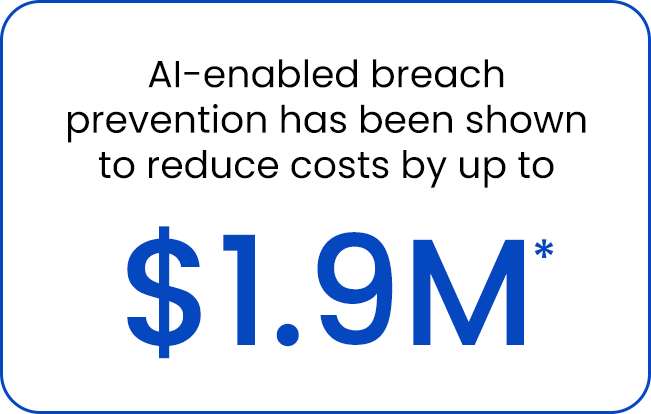
*IBM. Cost of a Data Breach Report 2025. IBM Security, 2025.
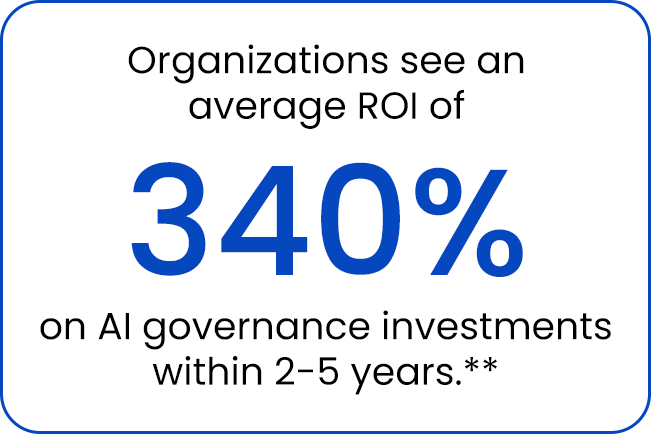
**AI Is Empowering Small Business Growth & Competition. Paramount Soft Blog, 2024.