
If the journey from managed service provider (MSP) to managed intelligence provider (MIP) starts with discovering where the opportunities for agentic AI are, you might be asking, when do we actually get to sell the thing? We’re glad you asked — that’s your next move! Play 2 of the The MIP Playbook, the Sell Play, is the moment where all your strategizing moves into monetizing agentic AI outcomes. Follow along as we explore the next play in your framework for transformation.
Why Does Outcome-Driven Pricing Matter?
Even after you’ve gone through the process of uncovering process debt and holding informational sessions with your clients during the Discover Play, your clients may still be scratching their heads about this whole agentic AI thing, and your team may be left wondering how to productize what it is you’re offering. That’s where outcome-driven pricing comes into effect. Rather than selling features and licenses, you’re selling tangible business outcomes.
These outcomes come in the form of monetizing AI agents’ ability to save time or reduce costs in measurable ways. So, rather than listing capabilities, you’re listing ways in which agentic AI will impact their business and make it more competitive. Improving customer satisfaction scores? Check. Quicker time-to-market? Can do. This helps you move past strategy to a signed agreement.
How Does Outcome-Centric Selling Work?
Traditional MSP sales answer: What does this technology do? MIP sales answer: What measurable change does this create, and what is that worth? If you can’t quantify the last step, you don’t have a sellable AI service. You have a demo. Successful MIPs follow a clear, repeatable approach:
- Start with the client’s priority metric: Identify what matters most right now. Is it cost reduction, faster resolution times, revenue growth or compliance accuracy?
- Translate agent capability into that outcome: Instead of saying, “This agent automates support tickets,” say, “This agent cuts ticket resolution time by 40%, so your staff isn’t stuck waiting on little fixes and focus on more important tasks.”
- Use numbers, not features: Instead of overly technical details (yawn), give them proof points — 95% accuracy! $50K annual savings!
- Package offers around results: When they say “yes, please!” to those outcomes, build tiers or bundles accordingly, such as “up to 100 resolved requests per month” or “95% successful resolution guaranteed.”
- Tell the before‑and‑after story: Show how their current state isn’t working (manual, slow, costly, same old story) compared to the future state (automated, fast, scalable, forward-looking).
With this approach, you’ll shift from selling what the technology does to selling what the client gains. This outcome-first mindset builds urgency, strengthens trust and justifies pricing.
What Are the Steps in the Sell Play?
The Sell Play takes place across five distinct steps, moving you from defining success to running pilots that prove ROI.
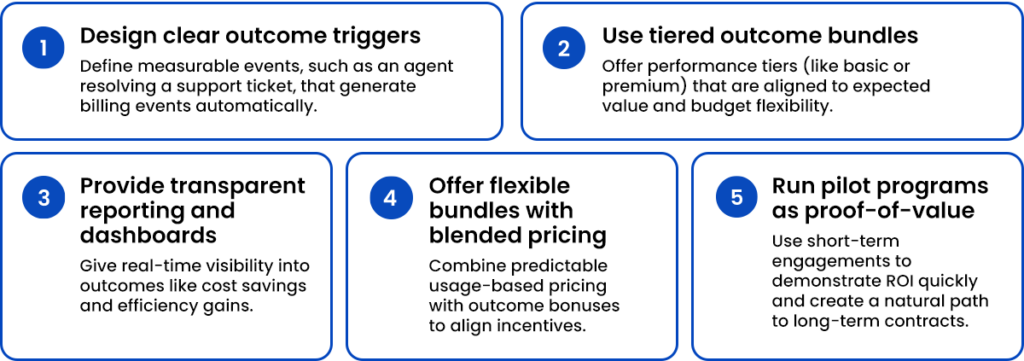
- Design clear outcome triggers
Define measurable events, such as an agent resolving a support ticket, that generate billing events automatically. - Use tiered outcome bundles
Offer performance tiers (like basic or premium) that are aligned to expected value and budget flexibility. - Provide transparent reporting and dashboards
Give real‑time visibility into outcomes like cost savings and efficiency gains. - Offer flexible bundles with blended pricing
Combine predictable usage‑based pricing with outcome bonuses to align incentives. - Run pilot programs as proof‑of‑value
Use short‑term engagements to demonstrate ROI quickly and create a natural path to long‑term contracts.
What Are Some Effective Use Cases in the Sell Play?
If you’re still pricing AI like labor, you’re not selling intelligence — you’re reselling inefficiency. Outcome-based pricing increases trust, but it also shifts operational risk onto you, the provider. With outcome-aligned contracts, you are paid only when you deliver measurable results. Here are three ways for you to bring transparency, predictability and a shared risk.
Use Case 1: Outcome-Based Pricing (Pay for Results)
What it is: Tiered contracts charge per resolved case, qualified lead or on‑time invoice, with dashboards for clear reporting along with credits for missed targets.
How it works: Outcome-based pricing offers incentives and increases perceived value, tying cost directly to results.
How to prepare for monetization: Start with a 60‑day proof‑of‑value engagement, then move to outcome pricing once you prove baseline results.
Strategic advantage: Renewals follow proof. When value is measured monthly, retention becomes a byproduct, not a negotiation.
Use Case 2: Value Proof and Organizational Readiness
What it is: Use demos and SMB‑specific case examples along with readiness qualification (including process ownership, data access and change readiness) during the sales process.
How it works: Visible proof reduces perceived risk, while readiness checks prevent deals from stalling after the sale.
How to prepare for monetization: Embed short demos in proposals and include a readiness checklist to protect margins and improve sales‑to‑success alignment.
Strategic advantage: While competitors sell access (seats, licenses), you sell outcomes; shifting the buying decision from cost to impact.
Use Case 3: Organization Readiness as a Sales Differentiator
What it is: Your sales team should qualify based not just on budget and need, but also change readiness so that transformation succeeds.
How it works: Research shows MSPs and MIPs are shifting roles and responsibilities to focus on providing measurable value, and part of this shift entails zeroing in on deployments that will prove successful.
How to prepare for monetization: Try a “readiness checklist” addendum that gates projects until certain prerequisites are met.
Strategic advantage: Margin expands when risk is shared. Pricing tied to outcomes rewards precision, not effort.
Why Selling Outcomes Is the Turning Point for Partners
The Sell Play is where MIPs start inspiring belief in the possibilities of agentic AI by committing to clear, measurable outcomes. The most effective MIPs who’ve done this move beyond the old ways of selling features and licenses, and instead frame agentic AI around business impact, like reduced downtime faster or higher conversion rates.
Sure, outcome‑driven pricing can be difficult. Many partners are mixing approaches, offering subscription tiers, block-hour models or project-based pricing while tapping ROI to help make the case. By being flexible and listening to your client, you can adjust your stance as needed and start selling AI services not as some futuristic nice-to-have technology, but as an investment into the future of their businesses.
What’s Next in the MIP Transformation Journey: Buy
Once belief is secured and outcomes are clearly defined, the journey moves from persuasion to execution. That’s where Play 3: Buy begins. In the next Play, MIPs can confidently curate the agents and vendors they need to deliver on the promise they’ve uncovered and sold during the first two Plays.
Ready to take the next step? Get The MIP Playbook to explore the full six‑Play framework, and stay tuned as we dive into how MIPs source, bundle and deploy agentic solutions in Play 3: Buy.