
You’ve discovered the opportunity, sold the vision and curated AI agents for your small and medium-sized business (SMB) clients. Then, they throw a curveball with a request for something your off-the-shelf agents can’t deliver. That’s when you tap into Play 4 of the MIP Playbook: Build. In the Build Play, managed intelligence providers (MIPs) evolve from curators into creators, developing custom agents, proprietary workflows and intellectual property that competitors can’t replicate. Read on to dig further into the Build Play of The MIP Playbook.
How Building Intelligence Is Different Than Configuring Software
When you were only delivering SaaS, customization meant tweaking settings and configuring integrations. But in the agentic era, building means you’re actually creating digital workers. Far from Frankenstein’s monster, these are autonomous agents that can reason and act inside real-world business workflows.
If that sounds daunting, here’s the good news: Building is no longer reserved for specialized engineering teams. With today’s low-code and no-code platforms, any MIP can spin up agents in days, not months.
As your clients’ builder, you’re tasked with designing intelligent systems around the specific ways they operate. Every business has process debt and specific quirks and workflows that a generic agent can’t address. The Build Play gives you the tools and frameworks to close that gap and to monetize it.
What Are Horizontal and Vertical Agents?
MIPs who build well think in two dimensions. Horizontal agents are general-purpose building blocks — your customer support bots, scheduling agents, finance reconciliation tools and compliance monitors. They apply broadly across industries and scale efficiently.
Meanwhile, vertical agents are tailored to specific industries, like patient intake automation in healthcare or regulatory reporting in financial services. These agents command higher margins and deeper client loyalty because they’re specialized for more specific and sometimes highly regulated tasks.
When you stack both types of agents together into layered, end-to-end workflows, that’s when the magic happens. Building your own agentic workflows gets you closer to delivering an industry-specific operating system you can then take to other, similar clients.
Why You Should Build Your Own Agents
Just like enterprises, SMBs are no longer content with static subscriptions. They want bespoke solutions that can adjust to their specific workflows and adapt to changing conditions.
Standard marketplace agents can get you part of the way. But they can’t solve for those deeply proprietary, often invisible processes that live inside every client’s business.
The Build opportunity comes into play here for MIPs who invest in agent development. Whether through prompt libraries, reusable API frameworks, orchestration pipelines or data infrastructure, you can create assets that compound in value over time. A well-built agent can become a sticky, recurring revenue driver that deepens client relationships and is very difficult for competitors to replicate.
Building also opens entirely new monetization paths. Instead of seat licenses or hourly rates, you’re pricing on capabilities and outcomes aligned to the value of the digital labor you create. That level of differentiation changes you from being a technology provider to an innovator and a true strategic partner.
How to Get Started Building AI Agents as a Managed Intelligence Provider
Treat the Build Play as an evolving capability, rather than a one-off project. Start with what’s achievable with the technology you have available today while investing toward what’s possible.
1. Build Horizontal and Vertical Agents
Start by identifying where your expertise already lives. If you serve healthcare clients, build a patient intake or compliance reporting agent. If you support retail, try predictive inventory or POS-integrated customer service. Horizontal agents give you breadth and reusability, while vertical agents give you depth and differentiation.
2. Create Custom Agents for Proprietary Workflows
Every client has processes that standard agents won’t touch. These could be legacy systems, manual workarounds, undocumented institutional knowledge — those concepts and processes that don’t fit into a neat bucket. By mapping and automating these bespoke workflows, you can strengthen trust with your clients, ensuring they see you as their strategic advisor.
3. Stack Agents into Custom Workflows
Linking multiple agents together unlocks a level of automation your clients may not have even dreamed of. Picture combining a patient intake agent with claims validation and compliance reporting agents for a turnkey healthcare solution you can reconfigure as needed.
4. Build Agent Factories and Deployment Pipelines
Rather than building agents from scratch for every client, develop assets you can reuse, like templates, prompt libraries and API connector frameworks. Together, they make up what we call an Agent Factory. These pipelines allow you to rapidly configure and deploy agents across clients, reducing time-to-value while maintaining quality and reliability.
5. Invest in Data Infrastructure as Your Foundation
Agents are only as good as the data they work with. Before writing a single line of code, focus on the data tied to the specific process or outcome you’re targeting. Structured data governance leads to more successful AI projects, making this investment critical to everything that follows.
6. Package Agents for the Marketplace
Now that you’ve built an agent and proven it’s not all smoke and mirrors, don’t keep it a secret. Package your proprietary agents for broader sale in agent marketplaces. That’s how you turn your hard work into scalable, monetizable intellectual property (IP).
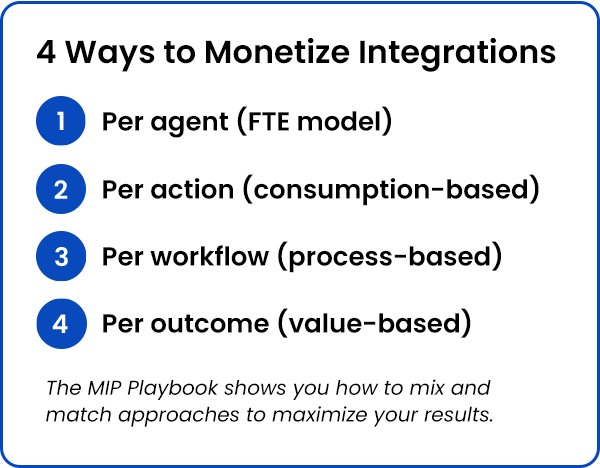
The MIP Playbook shows you how to mix and match approaches to maximize your results.
Real-World Ways MIPs Build AI Agents for SMBs
Master the Build Play to create the kind of proprietary, high-margin services that no competitor can copy. Here are a few examples of how you can design agents for scalable client outcomes.
Use Case 1: Agent Factory Pipelines (Templates and APIs)
What it looks like: Build a reusable factory pipeline consisting of the following: prompt and component templates, API connectors for CRM, ERP and PSA systems, evaluation harnesses and security patterns. The factory should also include orchestration tools for workflow sequencing and real-time monitoring dashboards for ongoing performance optimization.
How it works: Reusable frameworks accelerate agent development while improving reliability and compliance. When you add orchestration, monitoring and optimization to the framework, you create transparency and open a new revenue layer beyond licensing.
Your monetization move: Selling factory time in bronze, silver or gold builds plus an optional managed orchestration package equals reliable agents that deliver ROI (and recurring revenue) over time.
Use Case 2: Data Readiness as a Build Multiplier
What it looks like: Before you deploy a single agent, conduct a focused data readiness engagement targeting a single high-value process, such as ticket triage, quote-to-cash or invoice processing. Don’t aim to overhaul their entire data architecture. You’ll just want to look at the datasets tied to that workflow, then clean and structure them, so the agent has what it needs to perform accurately from day one.
How it works: Narrow the scope to make the data project faster and less expensive. This also helps you target early wins, so you can move to deployment faster.
Your monetization move: Productize data readiness as a prerequisite for every agent build and bundle it with your solution design phase. Once you establish trust and your client sees results, you can upsell broader data governance as a standalone service.
How The Build Play Helps You Create Value
The Build Play is where you go beyond what’s already on the market and start to truly innovate. By developing custom agents and deploying reusable factory pipelines, you create proprietary assets that help your clients see you in a different light while generating more recurring revenue.
But even the most innovative agents don’t create value the moment they’re built. You have to take that blueprint and bring it to market by connecting it to systems and embedding it into workflows, so your clients can use them with confidence.
That challenge leads directly to our next play, Implement, where you turn an agent from an idea into a working capability that delivers measurable outcomes in the real world. Check back with us to learn more as we explore the Implement Play of MIP transformation.
Don’t want to wait? Download the MIP Playbook and start exploring Play 5: Implement now.
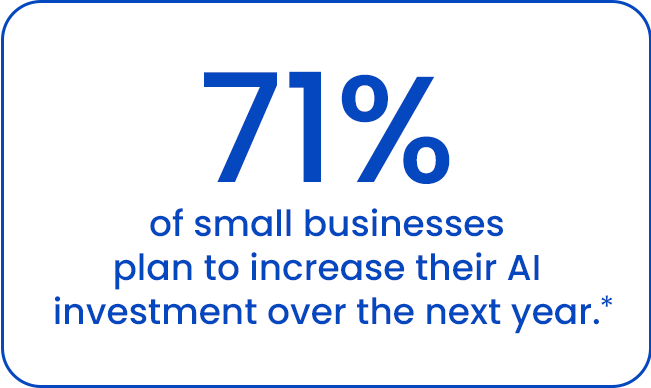
*Poon, Kristie. “AI and the Future of Small Business (A Trends Report Recap).” Salesforce Blog, Jun. 5, 2025.