
Now that you’ve worked hard to Discover agentic opportunity, Sell agents, Buy them and even Build them, you’ve got to make sure they work for your clients. It isn’t enough that they’re designed well; they need to change how your clients run their businesses. That gap between “deployed” and “adopted” is where most AI initiatives fall apart — and that’s exactly where managed intelligence providers (MIPs) have the chance to set themselves apart in the AI space. Play 5 of the MIP Playbook, Implement, is where design becomes operational reality: workflows get redesigned, systems get connected, people get trained and outcomes become something measurable. Here’s how to do it right.
Why the Implementation Process of Managed Intelligence Is So Crucial
In the agentic era, implementation is a lot more involved than deploying software. You need to take a holistic approach that involves optimizing technology, people and processes.
When AI projects fail, it’s less that the technology didn’t work than that the organization wasn’t ready. Gartner predicts that more than 40% of agentic AI projects will be canceled by the end of 2027 due to challenges like governance gaps, unclear value and poor adoption. Meanwhile, 74% of companies plan to deploy agentic AI within two years, yet only 21% report having a mature model for governing autonomous agents, limiting usability.
PwC reinforced this notion when it reported that 56% of companies are getting no measurable benefits from their AI investments. That’s largely because they skipped the foundational work required to make AI work within day-to-day operations. The technology was there. But the process, training and governance weren’t.
This gap is where you, the MIP, can help ensure SMBs’ AI investments aren’t in vain. From testing agents to launching them and helping clients train their employees, MIPs can make the right implementation process a repeatable, high-margin service that deepens client trust and generates ongoing revenue.
How to Implement AI Agents as a Managed Intelligence Provider
Implementation can be broken down into three pillars: technical, process and people. Follow each step carefully to avoid any missteps or delays in delivering outcomes.
Technical
The technical side of implementation comes down to connecting agents to your clients’ real-life business environment. That means integrating with identity and access controls, data sources, systems of record, API and MCP layers, logging, monitoring and version control. And, back to the governance part, it means implementing secure data handling, auditability, escalation paths, human override capabilities, and creating clearly defined boundaries for what each agent can and can’t do.
One of the most important (and often overlooked) principles is system design clarity. The real risk in any agent deployment is deploying them without clear architectural thinking. Each agent must have a well-defined scope that end users understand, so agents complement workflows rather than create confusion inside them.
Process
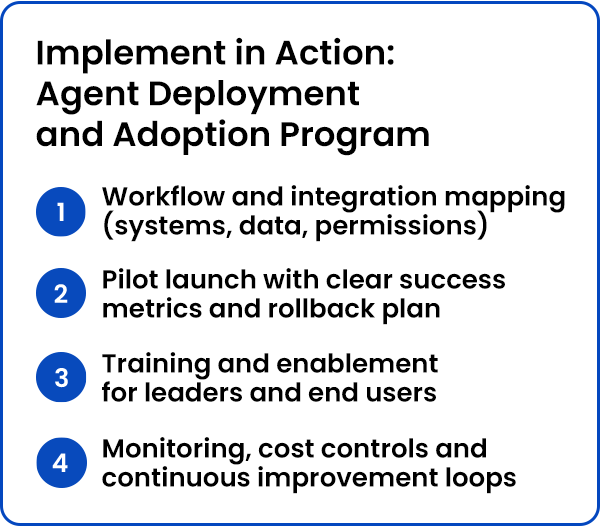
Implementation should follow a structured lifecycle: scope, readiness assessment, build, test, pilot launch, monitor and improve. Your SMB clients may not already have clean, clearly documented workflows ready to automate, so this step is important.
Before you make any agent go live, you’ll need to lead the work of mapping what actually happens in your clients’ day-to-day workflows that will involve agents. This will involve stakeholder interviews, process capture and exception mapping, so the agent has a solid foundation and boundaries to operate within — no rogue agents, please!
Want to really make sure agents behave? Try a controlled pilot launch. Rather than rolling out organization-wide, start with one workflow, one team and a defined rollback plan, if things go south. That way, you can build trust with internal champions early on and create proof of value to accelerate broader adoption.
People
Your clients might have fancy new agents, but they’re not going to use them unless employees trust your agents and know how to work with them. Implementation should include structured, role-based training for leadership, managers and front-line teams.
Training sessions will go beyond the “how to’s” of working with chatbots. It’s more about how workflows, expectations and responsibilities shift once agents are in play.
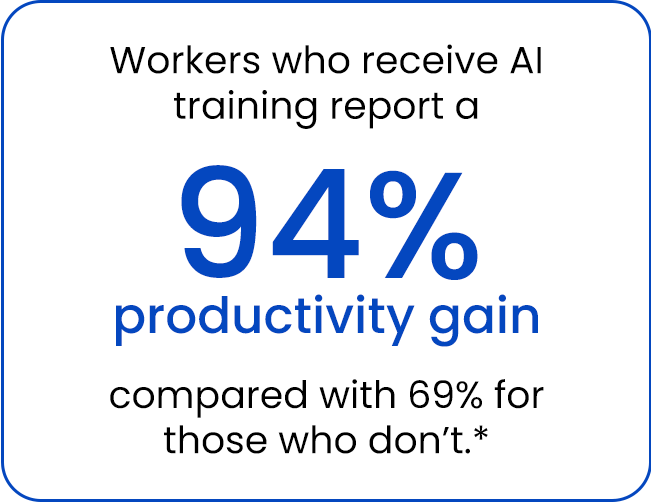
Avoid the temptation to skip this step. Training helps you and your clients reduce fear around AI agents and eliminates shadow AI behaviors. It also helps you protect ROI by preventing misuse and unclear prompting, which can drive spikes in cost and stall adoption.
Real-World Ways MIPs Implement AI Agents for SMBs
Below are examples of how you can structure implementations that make agents more operational.
Use Case 1: Agent Deployment and Adoption Sprint
What It Looks Like: Runs a structured, time-boxed implementation motion (typically two to six weeks) to take an agent from approved to in-use. This includes technical setup (identity, access, integrations and guardrails), workflow mapping, a pilot rollout and role-based training. The sprint ends with go-live metrics and an operational handoff plan, so the agent becomes part of daily work rather than a short-lived experiment.
Why It Works: Most AI initiatives fail at the implementation stage because workflows aren’t redesigned, and teams aren’t trained to adopt the new way of working. A structured sprint addresses both, improving adoption and minimizing misuse-driven cost spikes that erode ROI.
Your Monetization Move: Productize this as a fixed-fee implementation sprint with tiers: one workflow, three workflows or a full department rollout. Upsell into a subscription by bundling quarterly optimization and adoption reinforcement.
Use Case 2: Workflow Discovery and Process Mapping
What It Looks Like: Lead a lightweight workflow excavation engagement to help a client identify and document repeatable processes before any AI is deployed. This would include stakeholder interviews, process capture, exception mapping and readiness scoring to determine what can be automated now versus later. The output becomes the blueprint, so you can implement agents successfully and create a foundation to measure outcomes.
Why It Works: SMBs often can’t clearly articulate their own workflows, which means AI implementation goes beyond technical and into business consultancy. Establishing clean, documented processes before deployment helps you accelerate implementation when it does happen, so you can prevent the all-too-common failure pattern of deploying AI into organizational chaos.
Your Monetization Move: Sell this as the front door to every agent deployment — “no workflow, no automation.” Bundle it into the Sell and Buy plays as a paid assessment, then credit the fee toward the full implementation sprint to accelerate commitment.
Use Case 3: Integration and Guardrails Package
What It Looks Like: Implement the full technical foundation required for agents to safely operate inside real systems of record. This includes integrating the agent with business applications, configuring identity and role-based access, setting escalation paths, establishing logging and human override capabilities, and embedding governance-by-design.
Why It Works: Agents need systematic connectivity to function, and they need guardrails to function safely, especially when it comes to interacting with customer data or external-facing systems. Strong integration equals higher success rates.
Your Monetization Move: Position this aspect as the agent enablement layer that turns purchased or built agents into fully operational ones. Charge per integration and per workflow. You can even create a premium tier for regulated industries or high-risk processes where governance requirements are more stringent.
The Next Step After Implementing Agentic AI
The Implement Play is all about people and systems coming together to make measurable outcomes. When you treat implementation as a disciplined, repeatable lifecycle rather than a one-time deployment, you turn agents into working digital labor that delivers value every day.
But going live is just the beginning. Once an agent is deployed, you can create a competitive advantage by keeping it effective, improving it continuously and scaling what works. That’s exactly where our next play takes us: Manage.
Check back to learn more as we explore the Manage Play of MIP transformation. Can’t wait? Download the MIP Playbook and start exploring the Manage Play now.
*Zapier. “Most Workers Spend 3+ Hours per Week Cleaning up AI Workslop,” Jan. 14, 2026.